http://1up-games.com/md/gynoug/boss.html
Somehow the guy from 1-up games got a hold of some illustrations from Gynoug's illustrator Satoshi Nakai. Look too good to be manual scans. Pixiv perhaps?
Also, there's some boss design analysis (for instance if you squint really hard while looking at a particular boss you'll see something that could be MAYBE construed as a massive penis). I had no idea about the Time Bandits reference.
Games
[MD] Gynoug
Moderator: JC Denton
First unread post • 7 posts
• Page 1 of 1
 by Eboshidori » 14 Dec 2009 01:08
(for instance if you squint really hard while looking at a particular boss you'll see something that could be MAYBE construed as a massive penis)
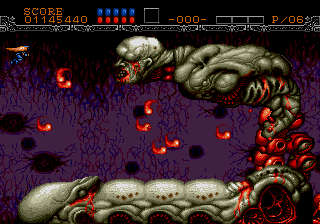
It's not "maybe", it IS.
Many Japanese games have phallique representations.
That's why this advertising is fun, for exemple:

-

Eboshidori - Joined: 06 Dec 2009 00:12
- Location: France
by JoshF » 14 Dec 2009 01:39
http://fr.wikipedia.org/wiki/SarcasmeIt's not "maybe", it IS.
And lol, I never noticed they fired a rocket at the boss to make an explosive testicle.
-
JoshF - Joined: 14 Oct 2007 14:56
by zinger » 14 Dec 2009 09:26
They are in the manual, but these particular files have been snatched from Nakai's hompage:

Some of his work is awesome. I was trying to find my favourite (an old man with tens of heads), but I can't seem to find it now. Maybe he took it offline.
Some of his work is awesome. I was trying to find my favourite (an old man with tens of heads), but I can't seem to find it now. Maybe he took it offline.
-

zinger - Joined: 22 Oct 2007 16:32
- Location: Sweden
by Eboshidori » 14 Dec 2009 23:19
JoshF, I should have noticed the sarcasm, indeed. In this case, the graphic part was really obvious. But that's not always the case.
At the time, I enjoyed many games which featured more or less clearly organic symbols (Gynoug, R-Type, Kujaku-Oh 2, Devil Crash ...), and I didn't notice everything (I was too young).
Nowaday, most are obvious, but you can still miss some details.
At the time, I enjoyed many games which featured more or less clearly organic symbols (Gynoug, R-Type, Kujaku-Oh 2, Devil Crash ...), and I didn't notice everything (I was too young).
Nowaday, most are obvious, but you can still miss some details.
-
Eboshidori - Joined: 06 Dec 2009 00:12
- Location: France
by icycalm » 05 Mar 2011 23:29
http://insomnia.ac/reviews/megadrive/gynoug/
This review makes a point that I also made, in another context, in my Braid review. Try to see if you can find it.
This review makes a point that I also made, in another context, in my Braid review. Try to see if you can find it.
-
icycalm - Hyperborean
- Joined: 28 Mar 2006 00:08
- Location: Tenerife, Canary Islands
by chb » 06 Mar 2011 17:42
I guess you're talking about this paragraph:
This is similar to the part in your Braid review where you wrote about the game's theme:
The point that both passages have in common is that if you're designing a videogame, the aesthetics and the theme should be on an equal level with the mechanics. If they're not, the game ends up being less immersive, which is what the composer for Gynoug realized but Jonathan Blow didn't.
zinger wrote:Writing the music must have been a really difficult job with an STG such as this one, though (where very little happens during the first stages), because an arrangement that is too dramatic or with too much going on in general would have made the shooting action look even blander in comparison. I first fully realized this when I turned off the sound completely and put on some of the music from Landstalker (1992, composed by Motoaki Takenouchi) instead, which fits Gynoug very well in theme (at least a few of the tracks), but is complex to the point where a single composition from that game contains more action than even the shooting in Gynoug's first three stages put together — a contrast which produces an outright comical effect! So, Iwadare's modest approach might have been the best option anyway, though that doesn't save it from being extremely boring of course.
This is similar to the part in your Braid review where you wrote about the game's theme:
icycalm wrote:I mean, isn't it by now obvious why, even in purely thematic terms, something like Super Mario World is infinitely more immersive than tripe like Braid or Knytt or Passage? Ask yourselves: How can it be that the childish platformer is more immersive than the "serious" platformer? PERHAPS BECAUSE THE VERY CONCEPT OF THE PLATFORMER IS CHILDISH TO BEGIN WITH, AND CONSEQUENTLY WORKS BETTER WHEN PAIRED WITH AN EQUALLY CHILDISH THEME?
The point that both passages have in common is that if you're designing a videogame, the aesthetics and the theme should be on an equal level with the mechanics. If they're not, the game ends up being less immersive, which is what the composer for Gynoug realized but Jonathan Blow didn't.
-
chb - Joined: 16 Jun 2009 07:33
- Location: Germany
7 posts
• Page 1 of 1